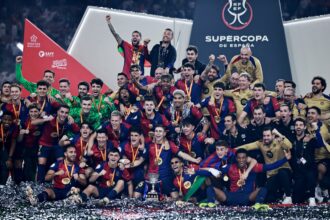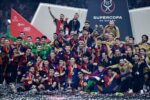
Just 24 hours after the Spanish Super Cup defeat to Barcelona, Real Madrid officially announced a “mutual agreement” to part ways with head coach Xabi Alonso. In reality, few inside Spanish football believe this was anything other than a presidential sacking driven by pressure, optics, and power dynamics.
From an analyst’s perspective, this decision says far more about Real Madrid’s institutional culture than it does about Alonso’s performance.
The Official Line vs Football Reality
Technically, Real Madrid framed the decision as a mutual separation. Practically, it was a classic Florentino Pérez reactionary move—swift, ruthless, and shaped by media noise rather than football logic.
- ❌ Appointed as long-term successor to Carlo Ancelotti
- ❌ Dismissed after just 34 matches
- ❌ Removed while still four points off Barcelona in La Liga
- ❌ Win rate of 71%, higher than any Madrid coach in the past decade
In elite football, results matter. But at Real Madrid, narrative control matters more.
Why Xabi Alonso “Never Had a Chance”
A Club Built Around Stars, Not Systems
Under Florentino Perez, Real Madrid has long operated under the Galácticos doctrine—where star power outweighs structure, and managers are disposable intermediaries.
At the Bernabéu:
- Player hierarchy trumps tactical hierarchy
- Big names shape the dressing room climate
- Coaches are expected to win immediately, without friction
Alonso walked into a squad dominated by unchecked superstar influence, not a resettable project.
Dressing Room Power Struggles
Several incidents during Alonso’s short reign reveal a deeper issue:
- Vinicius Junior visibly protested substitutions
- Kylian Mbappe reportedly bypassed Alonso’s authority, instructing teammates to ignore a potential Barcelona guard of honor
- Tactical discipline suffered when egos felt challenged
These are not coaching failures. These are structural failures of governance.
Alonso’s Credentials Were Never in Question
To suggest Xabi Alonso was unqualified is revisionist history.
As a Player
- Champions League winner with Liverpool and Real Madrid
- Central figure in Spain’s golden era
- League titles in Spain and Germany
As a Coach
- Historic treble with Bayer Leverkusen (Bundesliga, DFB-Pokal, Supercup)
- One of Europe’s most sought-after young managers
- Student of elite tacticians: Aragonés, Benítez, Del Bosque, Mourinho, Guardiola, Ancelotti
Alonso arrived at Madrid as a proven modern coach, not an experiment.
The Super Cup Loss Was Not a Failure
From a technical standpoint, the 3–2 loss to Barcelona was a fine-margin match:
- Two goals conceded in stoppage phases
- Deflected winner
- Missed late chances
- Mbappé returning from injury
Madrid were competitive, organized, and tactically coherent for long stretches. This was not a collapse—it was football.
Sacking a coach over a single El Clásico final reflects institutional impatience, not elite standards.
The Absurdity of the Timing
Alonso was dismissed after:
- 232 days in charge
- A 71% win rate
- A manageable title race position
- Clear signs of tactical direction
No serious football project can be built under those conditions.
Álvaro Arbeloa Next? Same Fate Likely
Early indications suggest Alvaro Arbeloa—another club legend—may step in.
But history tells us:
- The name doesn’t matter
- The philosophy doesn’t matter
- Time is never granted
Until Real Madrid recalibrates its internal power balance, every coach is temporary.
The Real Issue: Florentino Pérez’s Cycle
This is not new. Pérez resigned once before in 2006 under similar chaos, only to return and repeat the pattern.
At Madrid:
- Long-term planning is cosmetic
- Stability is sacrificed for headlines
- Coaches clean up structural messes they didn’t create
Until that changes, managerial turnover will remain inevitable.
Contrast With Barcelona: Why Flick Is Thriving
While Madrid spirals, Barcelona thrives under Hansi Flick:
- Clear authority structure
- Tactical buy-in from players
- Trust in process
Four straight El Clásico wins is no accident—it’s governance.
Final Analysis: A Club at War With Itself
Xabi Alonso deserved time, authority, and protection. Instead, he became another casualty of a club addicted to immediacy.
The Spanish Super Cup final didn’t end Alonso’s Madrid career.
Real Madrid’s culture did.
Until power shifts from egos to structure, chaos will continue to reign at the Bernabéu—no matter who stands on the touchline.